Welcome To The Official Website Of Author
The Best-Selling Book Author That Captivates and Inspires
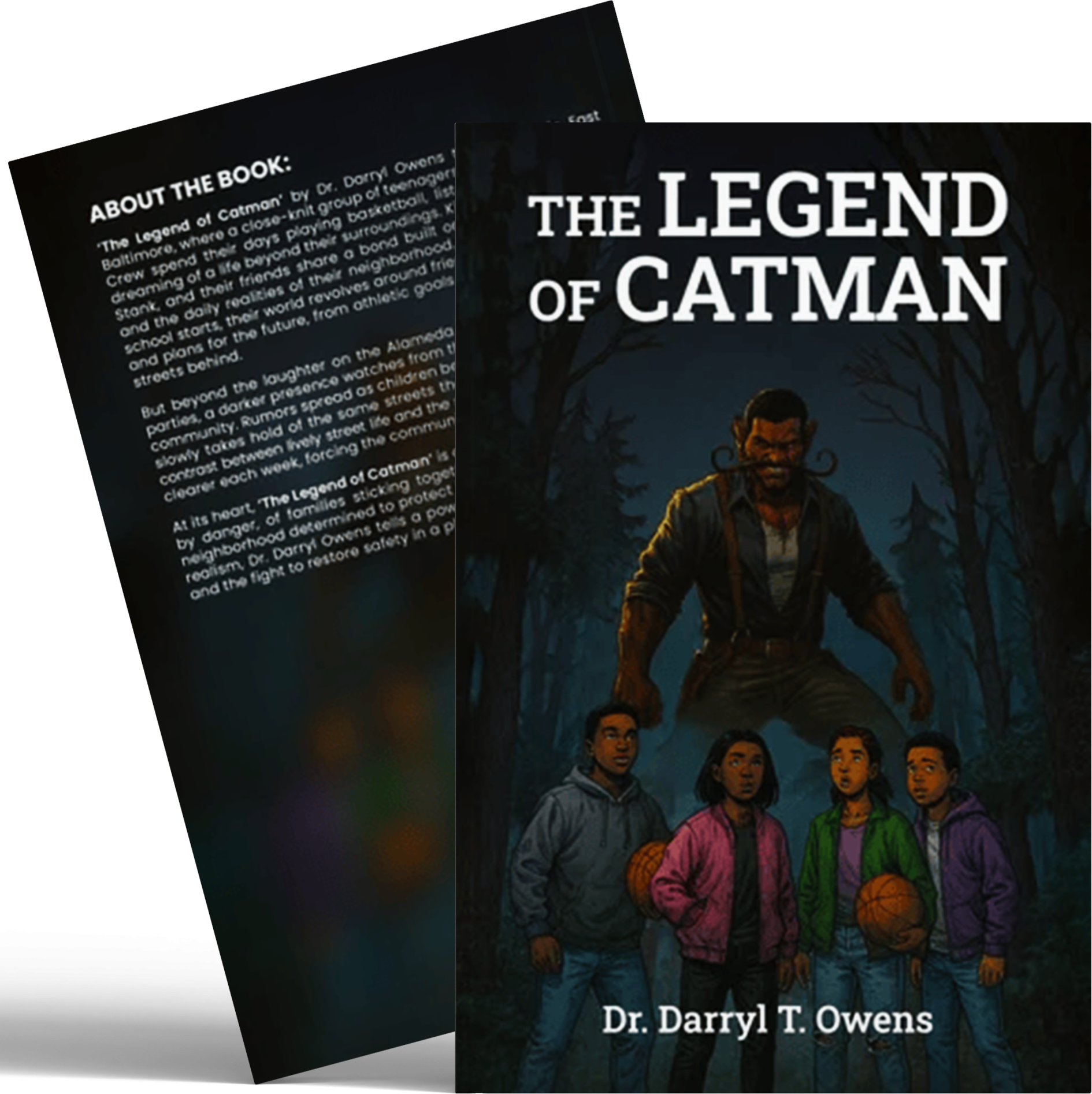
East Baltimore, 1979. The East Side Crew owns the streets through basketball, music, and brotherhood. But something watches from the woods. The Catman. A shadowy figure tied to Gullah folklore and a trail of disappeared children. When Little Man’s brother Turner vanishes into those same woods, childhood ends in an instant. Twenty five years later, the murders begin again. And the crew realizes the monster they survived never left. Some legends refuse to die.

About The Author
Dr Darryl Owens
Dr. Darryl Owens writes stories that sound like real neighborhoods: kids on stoops, music in the distance, jokes flying fast, and danger sitting quietly in the background. His work leans on street-level detail and strong characters, the kind you feel like you’ve met before. He doesn’t dress things up. He shows the choices people make when life is loud, money is tight, and pride matters.
In The Legend of Catman, he brings East Baltimore to the page with a mix of friendship, grit, and suspense. You’ll meet teens who are trying to figure out who they are, families holding it together the best they can, and a community that has to face a threat it can’t explain. Owens writes with pace, tension, and a clear love for the way people talk and live when they’re just trying to make it through the week.
He writes urban suspense where loyalty gets tested, shortcuts have costs, and readers stay for the heart behind it.
When he isn’t writing, Dr. Owens focuses on creating stories that keep readers turning pages while still feeling grounded and honest.
About The Book
THE LEGEND OF CATMAN
The East Side Crew rules their Baltimore neighborhood through loyalty, laughter, and dreams too big for the streets that raised them. Kip has NBA talent. Little Man wants a baseball scholarship. Fat Boy brings the music. Together, they survive poverty, systemic racism, and the daily grind of growing up Black in late 1970s America.
Then children start disappearing. Whispers spread about the Catman, a figure from Gullah folklore who hunts in the woods bordering their world. When Turner chases a basketball into those trees and vanishes, Little Man and Kip face the legend directly. They bring Turner home alive. But the trauma never leaves.
Twenty five years pass. The crew builds lives: attorney, educator, NBA player, preacher, politician. They escape East Baltimore but cannot escape the past. New murders surface with the same signature. The Catman is back. Or maybe he never left.
Now adults with everything to lose, the East Side Crew must return to the neighborhood that shaped them and confront the monster that has haunted generations. Some debts demand payment. Some legends demand reckoning.
Choose Your Preference:
Watch Video Trailer
THE LEGEND OF CATMAN
This heartfelt preview explores the Catman legend rooted in Gullah folklore, the disappearances that haunted their neighborhood, and the moment Turner vanished into the woods. Discover how friendship, community resilience, and confronting generational violence shape this urban suspense story where some legends refuse to die and some debts demand payment decades later.
Testimonials
What Clients Says
Readers share how ‘The Legend of Catman’ resonated with their experiences of community, loss, and confronting the past. These responses reflect the novel’s impact on understanding urban folklore and generational trauma.
The East Side Crew felt like people I grew up with. The trash talk during basketball, the way they protected each other, the dreams of escaping through sports or education while staying loyal to the neighborhood. Dr. Owens captured that tension perfectly. You want to leave but you cannot fully abandon the place and people that made you. When they reunite as adults, that bond still holds despite different life paths. That authenticity made the horror elements hit harder.

Martin Guptil
Photographer
What struck me was how the book handled grief. Will’s death during the snow football game, the dry funeral food, Ms. Pam’s fried chicken afterward bringing the family back to earth. Those details felt real. Grief is not just crying. It is eating terrible food at a repass and then going home to something familiar that reminds you life continues. The funeral scene where the congregation catches the Spirit, turning mourning into celebration, captured how Black communities process loss collectively.

Chris Eric
Writer
The Catman’s connection to Gullah folklore added depth beyond typical urban horror. He is not just a random serial killer. His family’s history of fleeing South Carolina after violence, bringing survival skills north, shows how trauma travels across geography and generations. Loretta explaining his origins made him more terrifying because he represents real historical displacement and the darkness that sometimes accompanies survival.

Jessica
C.O
The police racism felt painfully accurate. Officer Wilson treating Little Man and Kip with immediate suspicion and disrespect after they rescued Turner. Arresting Jonah, a homeless man, without real evidence. The investigation going nowhere because the victims are Black children in a poor neighborhood. The book exposes how systems fail communities, allowing predators to operate because authorities do not care enough to protect certain lives

James
I appreciated the twenty five year time jump showing where each crew member ended up. Kip in the NBA, Little Man as an attorney, Fat Boy as an educator, Big Man in security, Truth as a preacher, Turner in politics. They achieved their dreams but could not escape the past. When new murders surface with the same signature, they have to retur. That structure shows how trauma does not disappear just because you leave physically. It waits.

Olivia
The revelation that the Catman hid in the woods behind the Post Office for decades, never leaving Baltimore, was chilling. He survived through old knowledge, watching the neighborhood change while remaining constant. That image of a predator embedded in a community, invisible to those trying to move forward, speaks to how violence can persist when we do not confront it directly.